
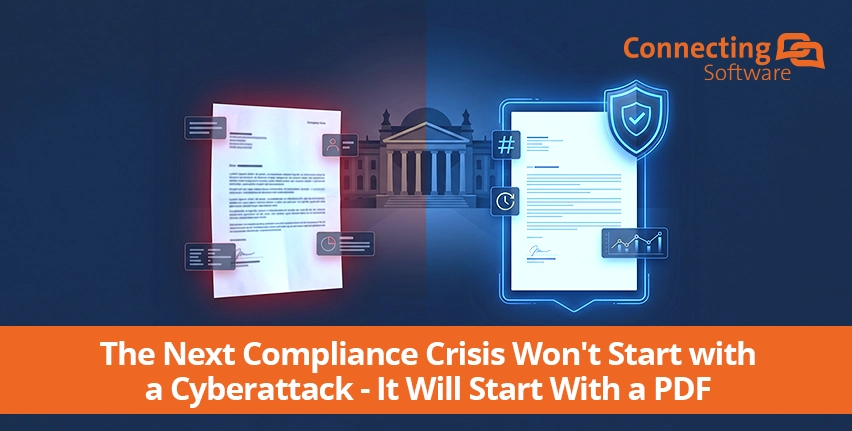
下一次合规危机不会始于网络攻击——而是始于一份PDF文件

Francisco RodriguesProducts and Solutions Leave a Comment

A German appellate court ruled that a digitally altered document - photographed and emailed - isn't legally a forgery, because it's recognizably just a photo of a document, not an original. No signature line. No criminal deterrent behind it. If your compliance program still treats "it looks official" as evidence of authenticity, this ruling should worry you more than your next zero-day alert. Below: what the Bavarian court decided, why the same gap reaches well past Germany, and where your document-verification controls are quietly assuming a legal backstop that no longer holds. The fix isn't legal. It's architectural.

What the Court Ruled

The case itself was mundane: a woman edited a genuine law-firm letter, printed it, photographed the result, and sent the image over WhatsApp and email. The Bavarian Higher Regional Court (BayObLG) acquitted her on both possible charges. First, a "document" under German law requires an embodied declaration that identifies an issuer and carries proof value - a signature is core to that. Without one, the court found only a non-binding draft with no evidentiary weight. Second, the offense of forging evidential data didn't apply either: an image file that's recognizably just a photo of a document functions as secondary evidence, not an original declaration carrier, so it falls outside that statute too.

This isn't just a German Problem

Fraud volume and sophistication are already rising independent of any single court's reasoning. PwC's Global Economic Crime and Fraud Survey found that just over half of surveyed organizations had experienced fraud in the prior two years - the highest rate in the survey's 20-year history, with platform-based fraud emerging as a fast-growing category.

Layer on generative AI and the picture worsens further. Gartner projects that by 2026, roughly 30% of enterprises will stop trusting standalone identity verification tools in isolation, specifically because AI-generated deepfakes now defeat face-biometric checks - and injection-style attacks against these systems jumped 200% in a single year.

U.S. federal agencies reached the same conclusion from the defense side. A joint advisory from the NSA, FBI, and CISA lays out how synthetic media threats have scaled across sectors and recommends concrete mitigation steps for organizations that can no longer assume media - visual or documentary - is what it appears to be.
Put together: a legal loophole in one jurisdiction plus a global arms race in fabrication tooling equals a compliance blind spot that doesn't care where your entity is domiciled.

What the Fix May Look Like

The underlying mechanism is a well-established one in cryptography, now increasingly applied to document integrity: hashing plus timestamping.

  • Fingerprint the file, not the content. A one-way cryptographic hash reduces any file - contract, filing, scan, dataset - to a unique fingerprint. The fingerprint reveals nothing about the file's contents; it only changes if the file itself changes, even by a single byte.
  • Anchor the fingerprint externally. Timestamping that fingerprint on a public blockchain (Bitcoin or Ethereum are common choices) creates a record that no single organization - including the one that created it - controls or can retroactively edit. The file's content is never uploaded or exposed; only the fingerprint is anchored, which keeps the approach zero-knowledge by design.
  • Verify independently, later, by anyone. At any point afterward, re-hashing the file and comparing it to the anchored fingerprint tells you, with mathematical certainty, whether the file matches what was sealed. No match means it's unchanged. A mismatch is detectable immediately, by anyone who runs the check - not just the party that sealed it.

None of this prevents someone from editing a file - nothing short of removing their access can do that. What it guarantees is that the edit cannot go unnoticed and cannot be plausibly denied. That's the piece the German court's reasoning couldn't reach: a photographed, unsigned document carries no built-in proof value, but a file with an externally anchored, independently verifiable timestamp carries exactly the kind of evidence the court found missing - regardless of what jurisdiction is asking.

Making the case for Digital Evidence Defensibility

This is a control-maturity gap, not a hypothetical scenario - you now have a specific court ruling, a Big Four fraud survey, and a joint U.S. government advisory all pointing at the same seam. Frame it that way with your board or audit committee: the ask isn't a large new budget line, it's a policy update - tiered document trust and out-of-band verification - that closes a gap your existing controls were never built to cover. Tooling investment can follow once the policy is in place and the exposure is documented.

.

想了解独立诚信核查在实际中是如何进行的吗?

免费试用——无需任何承诺:

知识产权创造者的真理验证器 https://truth-verifier.com/landing

记者真相核查员 https://truthverifier.news/landing

请联系我们,探讨 Truth Enforcer 的企业部署事宜: https://www.connecting-software.com/truth-enforcer-sign-up/


作者 - 弗朗西斯科-罗德里格斯

作者 弗朗西斯科-罗德里格斯产品经理

"我写的是软件集成如何适应业务环境并满足特定行业的需求。我希望通过向团队和 C-suite 高管提供正确的工具,为企业指明一条简化流程、消除瓶颈和确保合规的道路。


相关阅读

发表回复

您的邮箱地址不会被公开。 必填项已用 * 标注

For security, use of Google's reCAPTCHA service is required which is subject to the Google Privacy Policy and Terms of Use.