
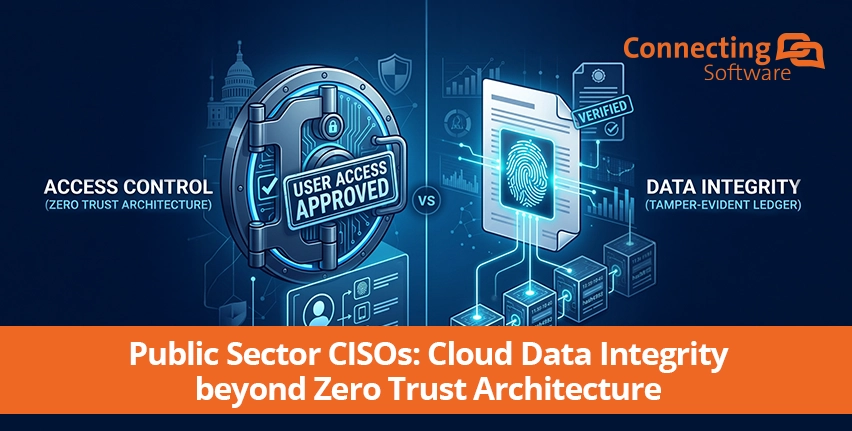
Public sector CISOs have mature Zero Trust controls. But Zero Trust Architecture is an access model, not an integrity model - and those are not the same thing. Here is the gap, and a decentralised mechanism to close it.
You approved the cloud migration. You deployed Zero Trust Architecture. Your identity governance is mature, your access policies are tight, and your board has been briefed. From a perimeter perspective, the risk is managed.
Here is what that architecture does not give you: any cryptographic guarantee that the data inside your cloud provider's infrastructure has not been silently modified after you put it there. Not by an external attacker. Not by a coerced administrator. Not by the provider itself operating under a legal instrument you were never notified about.
Access control and data integrity are not the same architectural property. In most public sector cloud deployments, they are treated as if they are - and that conflation is one of the most consequential blind spots a CISO operating in government can carry.
Here, the boundary between the two is defined, it explains the threat profile that makes this distinction critical in public sector environments specifically, and walks through the mechanism - blockchain-anchored cryptographic fingerprinting - that closes the gap. It maps the compliance obligations that make addressing this gap a regulatory requirement rather than a discretionary architecture decision.
Zero Trust Access Controls Do Not Verify Content
Zero Trust Architecture is built on a principle NIST SP 800-207 states without ambiguity: no implicit trust is granted to assets or user accounts based on their physical or network location. Every access request is authenticated, authorised, and continuously validated. It is a rigorous, well-defined model for controlling who can reach what, under what conditions, and for how long.
It is not a model for verifying what that resource contains.
The distinction is architectural, not semantic. When your ZTA policy engine confirms that an authenticated, authorised user accessed a document at 14:23 on a Tuesday, it has done precisely what it was designed to do. It has no mechanism to determine whether that document reflects the same content it contained when it was originally written. The question - was this data modified between its last known good state and now - sits entirely outside the ZTA control plane.
NIST SP 800-207A, which extends Zero Trust principles to cloud-native and multi-cloud government environments, identifies a further structural limitation: in many government architectures, including air-gapped systems and federated multi-agency environments, a single unified control plane is infeasible. ZTA enforcement points simply cannot observe all infrastructure-level operations - particularly those occurring within the storage substrate your cloud provider controls.
That is the boundary. Your cloud provider has the technical capability, in many standard configurations, to access or modify data-at-rest without triggering a single ZTA policy alert. This is not an accusation of provider malfeasance. It is an architectural reality of the shared responsibility model - and it is precisely the gap that requires a separate integrity control layer independent of your cloud provider's administrative domain.
The Public Sector Threat Profile Is Not Generic
Every organisation faces insider threat risk. Public sector organisations face a version of it with consequences that extend well beyond the organisation's own operations.
A tampered procurement record does not just expose an agency to audit findings - it potentially corrupts a contracting decision affecting hundreds of millions in public expenditure. A modified policy document does not just create an internal inconsistency - it can invalidate a legislative or regulatory process. Citizen data integrity is not a commercial liability question. It is a public trust question with democratic accountability attached.
The Verizon 2024 Data Breach Investigations Report places public administration as the top industry sector for non-malicious insider threat actions. Across all sectors, 68% of breaches involved a human element - error, privilege misuse, or social engineering - with part of that breached data residing across multiple cloud environments. Government deployments, which routinely span on-premises sovereign infrastructure and one or more public cloud providers simultaneously, sit squarely in this multi-environment exposure profile.
The detection timeline compounds the exposure. The Ponemon Institute's 2025 Cost of Insider Risks Global Report places the average detection and containment window for insider threats at 81 days, with cloud environments identified as one of the concerns. In a government context, 81 days of undetected tampering means 81 days of potentially corrupted records informing policy decisions, supporting procurement processes, responding to parliamentary or congressional inquiries, and interacting with citizens. Every downstream action taken based on tampered data inherits its integrity failure.
The financial dimension adds further pressure. Malicious insider incidents now average $ 779,707 per event, with total annual insider incident costs reaching $8.8 million per organisation. For public sector entities, those costs are denominated in public funds and political accountability simultaneously.
The Decentralised Integrity Layer: What It Is and What It Does
The mechanism is conceptually direct and cryptographically robust. Crucially, it does not require your document to leave your possession at any point in the process.
For every document or data object you want to protect, a cryptographic hash - a unique digital fingerprint - is generated from its content using an algorithm such as SHA-256. The hash function takes the document as input and produces a fixed-length output string, regardless of whether the source document is a two-page briefing or a 10,000-page regulatory submission. That output is mathematically derived from every bit of the document's content at that specific moment. Change a single character anywhere - a decimal point, a clause, a metadata timestamp - and the resulting hash is entirely different.
This fingerprint is then recorded on a blockchain: an immutable, distributed ledger no single party controls. The record is time-stamped and tamper-resistant by the ledger's structural design. What is written to the chain is the fingerprint, not the document. The document's content, its classification, its parties, its terms - none of this is exposed. The ledger knows only that at timestamp T, a document with this exact content state existed.
Verification is the reverse operation. When you need to demonstrate to an auditor, regulator, or counterparty that a document has not been modified since it was sealed, you generate a new hash of the current document and compare it against the on-chain record. The determination is binary and mathematically certain. If the hashes match, the document is identical to its recorded state. If they do not, the content has changed - and a single character changed anywhere produces an entirely different hash. There is no ambiguity, no margin of interpretation, and no reliance on the provider's assurance.
The tamper-resistance of the ledger is structural. Each block's hash includes the hash of the preceding block. Altering any historical record requires recomputing every subsequent block and achieving consensus across the entire distributed network simultaneously - computationally infeasible against any well-established chain. This is not a trust model. It is a mathematical constraint on the possibility of silent, undetected modification.
Public sector deployments typically implement a permissioned blockchain - Hyperledger Fabric being the most widely adopted enterprise governance pattern - where network participation is controlled and defined by the consortium. A hybrid architecture adds a second layer by periodically anchoring the permissioned chain's root hash to a public blockchain such as Ethereum. This hash-of-hashes commitment means that even if the permissioned network were compromised, the public chain provides an independently verifiable, globally timestamped proof. Your document content remains within your controlled environment throughout - the hash is what travels, not the file.
This is precisely the architecture that Port of Trust implements in production. Port of Trust is the cryptographic core of the Truth Enforcer framework - a blockchain-powered integrity layer designed to seal any file, record, or event with a cryptographic fingerprint and store proof on public blockchains, without any sensitive data ever leaving your environment. Only the hash is stored on-chain. The original document remains under your control. Verification is independently executable at any point - including years after the original seal - with full transparency and auditability, and without requiring system access or credentials from the verifying party. For public sector organisations that need this capability without the overhead of custom implementation, Truth Enforcer provides a production-ready application for sealing files operationally, with a companion Truth Verifier tool that allows auditors, regulators, and oversight bodies to confirm document authenticity through a public-facing interface - no internal system access required. The integrity proof is yours. It is independently verifiable. And it lives entirely outside your cloud provider's administrative reach.
Why This Is Cheaper Than the Alternative
The cost framing for a public sector CISO involves two simultaneous accountability channels that do not exist in the private sector in the same form: financial cost and public accountability cost. Both compound when tampered data goes undetected.
At the financial layer, the detection timeline is where costs accumulate fastest. The IBM Cost of a Data Breach Report 2024 establishes a $980,000 detection premium between breaches disclosed by the attacker and those identified internally - meaning every additional day of undetected tampering represents measurable financial exposure. At the Ponemon 81-day average detection window, that premium is not theoretical.
At the operational layer, the archival liability tail is the risk most consistently underestimated in government cloud programmes. Documents in archival operate under a reduced monitoring cadence and an assumption of stability. When that assumption fails - during a regulatory investigation, a freedom of information request, a parliamentary inquiry, or litigation discovery - the integrity failure is discovered at the worst possible moment, with the maximum possible consequences.
The implementation cost of a permissioned blockchain integrity layer, operated as a shared service across an agency or department, is substantially lower than a single malicious insider incident - before accounting for legal, regulatory, reputational, and political exposure. The sovereignty argument adds a strategic dimension: your integrity proof lives outside your cloud provider's administrative domain, persists independently of your provider contract, and travels with you across a renegotiation, a migration, or a termination. That is a programme asset, not an overhead.
Implementation Considerations for Public Sector Architectures
A blockchain-anchored integrity layer is cloud-agnostic by design. Whether your workloads run on AWS GovCloud, Microsoft Azure Government, a sovereign on-premises data centre, or a hybrid combination of all three, the hash layer operates identically across the estate. The governing principle does not change with the infrastructure: your integrity proof must always live somewhere your cloud provider cannot reach.
Deployment in government environments benefits from a classification-aware cadence. OFFICIAL-tier documents may be fingerprinted at write events and verified on a scheduled basis. OFFICIAL SENSITIVE and above warrant verification at every access event and egress point - with the hash, timestamp, and accessor identity logged as an additional on-chain record. Smart contracts enforce this workflow automatically: a policy defined in code that executes without human discretion, transforming access verification from a procedural activity into a cryptographic record that cannot be retroactively altered.
Integration with existing infrastructure is straightforward at the architectural level. Hash generation plugs into existing SIEM and SOAR workflows as an additional telemetry feed. For government organisations that manage significant document volumes through SharePoint - which remains the predominant document management platform across central government in the UK, Australia, and across EU member state administrations - Truth Enforcer for SharePoint embeds the sealing and verification workflow directly into the document library, without requiring users to change how they work or IT teams to build a custom integration layer. Secure Sync for SharePoint extends this further in multi-environment deployments, enabling policy-driven synchronisation of document libraries across on-premises, hybrid, and cloud SharePoint instances with filtering controls that enforce classification-aware data flows - ensuring that only approved, non-sensitive content transits between security zones while integrity seals travel with the document.
Immutable object storage configurations - S3 Object Lock, Azure Immutable Blob Storage - provide a useful procedural complement but remain within the provider's administrative domain and should not be treated as a substitute for an independent integrity proof. Archival manifests structured as Merkle trees provide mathematically verifiable reconciliation at the collection level - satisfying the requirement for integrity checks when recovering from ICT incidents, a provision directly applicable to NIS2-obligated government entities.
The governance question requires deliberate attention: these are programme governance questions, not technical ones. Who owns the blockchain node? Who defines and audits the verification cadence? How does integrity mismatch detection integrate with your existing incident response playbook? These belong in your cloud strategy documentation and your third-party risk management framework simultaneously - not resolved at implementation and never revisited.
Solving the Data Integrity Problem
Zero Trust Architecture was the right response to the perimeter's collapse. It redrew the trust model around identity, access, and continuous verification - and it did so correctly. But it solved the access control problem. The data integrity problem is a different problem, and it remains open in most public sector cloud deployments.
Your ZTA tells you who opened the document. It cannot tell you whether the document is the same document it was when you sealed it. That is not a gap in your access policy. It is a gap in your evidence chain - and in a government environment, your evidence chain is also your audit trail, your regulatory record, and your democratic accountability instrument.
Truth Enforcer closes that gap without complexity and without compromise. It extends your cryptographic chain of custody from the access event into the content state - giving you, your regulators, and your oversight bodies a verifiable answer to the question that matters most: has this data been silently changed since it was sealed? No sensitive content leaves your environment. No proprietary trust model is required. The proof is independently verifiable by anyone, at any time, with no system access needed.
Your cloud provider gives you infrastructure. The decentralised integrity layer gives you proof. In the public sector, proof is not optional.
.
Want to see what independent integrity verification looks like in practice?
Try it free - no commitment required:
Truth Verifier for IP Creators: https://truth-verifier.com/landing
Truth Verifier for Journalists: https://truthverifier.news/landing
Get in touch to discuss Truth Enforcer enterprise deployment: https://www.connecting-software.com/truth-enforcer-sign-up/


By Francisco Rodrigues, Product Manager
"I write about how software integrations can adapt to business environments and respond to industry-specific demands. I want to show enterprises the road to streamline processes, eliminate bottlenecks, and ensure compliance by empowering teams and C-suite executives with the right tools."