
The Consolidated Audit Trail (CAT) reporting under the Securities and Exchange Commission (SEC) Rule 613 has been effective for a considerable period. As such, most entities have their CAT reporting running with a reporting agent submitting everything on time, with error rates are within threshold. On paper, everything is right and these organizations feel completely covered. That is the problem.
Here is the question nobody in your last compliance review asked: if the SEC reconstructed a market event from your CAT submissions tomorrow, could you prove - not assert, not demonstrate process - prove that the data was never modified after submission?
If you cannot answer that with a verifiable artefact, you have a gap. And in the current enforcement environment, gaps in recordkeeping data integrity do not stay theoretical for long.
This article covers what that gap is, why it sits in a blind spot most firms do not know they have, what it has already cost firms that found out the hard way, and what closing it looks like in practice.
What Rule 613 Requires - And What It Silently Assumes
SEC Rule 613 mandates an accurate, time-sequenced record of orders from receipt or origination, documenting the full lifecycle through routing, modification, cancellation, and execution.
Every reportable event must be linked, timestamped to millisecond precision, and traceable across its entire lifecycle. Financial Industry Regulatory Authority’s (FINRA) implementing rules cover reporting to the CAT, clock synchronisation, timestamps, connectivity, recordkeeping, and timeliness, accuracy and completeness of data requirements.
What the rule does not address - anywhere - is how a firm proves that a submitted record was never altered after the fact. It mandates the data. It does not mandate the mechanism that guarantees the data you submitted is the data that still exists. That assumption is left implicit. Implicit assumptions are where enforcement exposure lives.
One Altered Record equals a Broken Chain
Consolidated Audit Trail reporting is not just a reporting task - it is a data integrity mandate with a cross-market surveillance capability built on top. FINRA uses the Consolidated Audit Trail to reconstruct the complete lifecycle of every NMS (National Market System) security and OTC (Over-the-Counter) equity order across every venue it touched, from the moment a customer order arrived at a broker-dealer's desk to every routing decision, every partial fill, every modification, and every post-trade allocation.
That reconstruction depends entirely on stable, unbroken linkage. A timestamp shifted by a fraction of a second. An order ID quietly corrected. A sequence record updated without a corresponding audit entry. Any one of these breaks the chain across potentially billions of correlated events.
FINRA expects firms to review the CAT Reporter Portal daily to catch integrity errors before they age into correction obligations. That review catches submission errors. It does not prove an accepted file was never modified after acceptance. Those are two different problems, and regulatory findings suggest many firms are not fully addressing both.
What Your Audit Log Cannot Prove
Access controls tell you who could have touched a file. Audit logs tell you what actions were recorded. Neither provides an independently verifiable answer to the question: did this specific file change between submission and now?
An internal log can be edited. A well-intentioned correction applied to the wrong record version leaves a process trail but no cryptographic proof of the file's prior state. In an enforcement context, the difference between "our logs show no unauthorised changes" and "we can prove this file is identical to what was submitted" is not semantic. It is the difference between assertion and evidence - and regulators know it.
Regulators view recordkeeping violations as making their job of market oversight and protection more difficult, and they take these matters very seriously.
What Non-Compliance Actually Costs
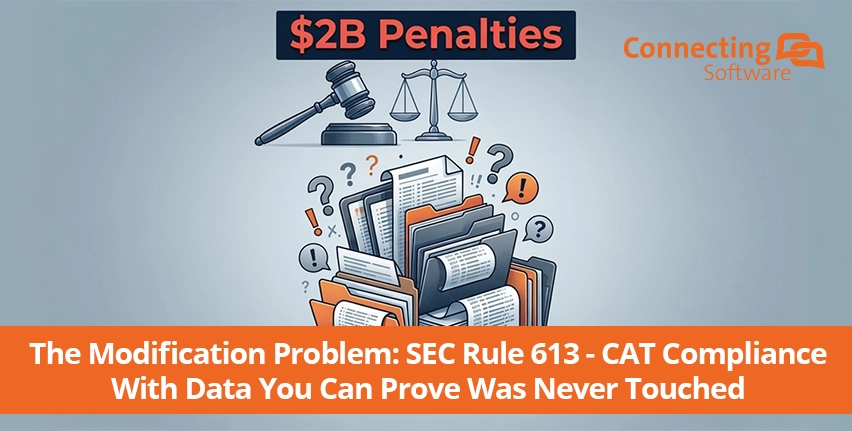
In fiscal year 2024, the SEC brought recordkeeping cases resulting in more than $600 million in civil penalties against more than 70 firms. Since December 2021, the initiative has resulted in charges against more than 100 firms and more than $2 billion in penalties.
A multi-million-dollar penalty was imposed on a firm for failing to timely and accurately report tens of billions of order events to the Consolidated Audit Trail central repository.
In a separate action, a broker-dealer's coding error caused millions of orders to be incorrectly marked over a five-year period. The firm agreed to pay a $7 million penalty and remediate the coding error.
The pattern is consistent: the SEC does not distinguish between intentional falsification and systemic data quality failure when calculating penalty exposure. And when remediation follows enforcement rather than preceding it, costs multiply. One firm that voluntarily self-reported suspected violations paid $2.5 million - substantially lower than the other firms charged in the same case.
Self-reporting helps. Provable integrity helps more.
The Cryptographic Answer
Blockchain technologies generate a hash fingerprint for a dataset. If a single value changes, the digest changes entirely, making even minor one-bit alterations immediately detectable.
NIST identifies this property as deterministic, one-way, and collision-resistant - meaning the same file always produces the same fingerprint, and no two different files can produce the same result.
This is where Truth Enforcer operates. At the point of CAT submission, it generates a cryptographic hash of the file and anchors it on a public blockchain. The file content never leaves the organisation - only the fingerprint is recorded on-chain. From that point forward, any version of the file can be independently verified against that anchored hash. Modified or not modified. The answer is mathematical, not procedural.
The model is create, seal, verify. It does not prevent modification. It guarantees that any modification cannot go undetected - converting a process attestation into a position that holds up under regulatory scrutiny. In regulated industries where audit is part of doing business, distributed ledger technology adds trust by maintaining integrity-protected records, making it straightforward to audit the process.
The Question to Take Into Your Next Compliance Review
Rule 613 never uses the words "file integrity." It does not need to. Every requirement it imposes depends on one unstated condition: that the records you submitted are provably the records that still exist.
The CAT NMS Plan requires data to be retained in a directly accessible electronic format for not less than five years. That is five years of potential exposure to the question of whether the data that exists today matches what was originally submitted - and five years during which any gap in provability compounds.
Most firms cannot answer the core question today. They can describe their process. They can produce their logs. What they cannot produce is a mathematically verifiable proof that a specific file is identical to what was submitted on a specific date.
The audit question to bring into your next compliance review: If the SEC requested verification that our CAT submission files were unmodified after transmission, what would we hand them - and would it hold up under scrutiny?
If the answer is a process description rather than a cryptographic proof, Truth Enforcer is built for exactly that problem.
.
Contact us at: https://www.connecting-software.com/truth-enforcer-sign-up/
OR
Try it for FREE:
Truth Verifier for IP Creators: https://truth-verifier.com/landing
Truth Verifier for Journalists: https://truthverifier.news/landing


By Francisco Rodrigues, Product Manager
"I write about how software integrations can adapt to business environments and respond to industry-specific demands. I want to show enterprises the road to streamline processes, eliminate bottlenecks, and ensure compliance by empowering teams and C-suite executives with the right tools."