
World-leading banks, global manufacturers, and government agencies now ask the same three questions before any major tech decision:
Where does our data reside?
Who really controls it?
And is it truly secure, given current threats?
_______________
As of 2026, more than 80% of the global population is already covered by modern data-protection laws. More than 140 countries now enforce data protection regulations, and the number continues to grow.
With privacy legislation now the norm, any organization holding personal or sensitive data must know where data is, who can access it, and how it’s secured—or risk massive fines, breach liability, and reputational damage. But there is more to data sovereignty than a compliance checkbox.
If you do not control your data, you cannot ensure it is available when your organization needs it. What happens if people can no longer access their files, their emails, or their digital calendar?
For these organizations, business continuity is key, and business continuity plans are the norm.
In a recent Uptime Institute study, 54% of organizations surveyed reported that their most recent significant outage cost more than US$100,000, and 16% incurred losses exceeding US$1 million.
If these are the numbers for a temporary outage, imagine the devastation of a permanent data loss tied to sovereignty failures: irrecoverable customer records, halted operations across borders, and regulatory penalties that can reach billions. True sovereignty is needed for business continuity, ensuring operations proceed even when threats isolate your systems.
A Current Trend: Air-Gapped, Sovereign Clouds
We’re currently seeing government and defense organizations globally take unprecedented steps to guarantee data control through air-gapped (physically isolated from external networks), sovereign cloud solutions.
A standout example comes from Germany’s Armed Forces. In June 2025, Germany’s Bundeswehr announced it is partnering with Google Cloud and its IT service provider BWI GmbH to deploy a fully air-gapped sovereign cloud, known as pCloudBW, within its own military data centers.
“With Google Cloud Air-Gapped as part of pCloudBw, the German Armed Forces receive a solution that they can actively control, thereby expanding their operational capability.”
This initiative involves creating two physically separate cloud instances—one for open data and another for protected, classified workloads—to meet the highest security standards while enabling operational independence. The air-gapped version of Google Distributed Cloud ensures complete isolation from external networks, including Google’s public infrastructure, allowing the Bundeswehr to process sensitive applications such as logistics systems, SAP enterprise software, and AI-driven analytics without risking exposure to cyber threats. By safeguarding data flows in isolated environments, pCloudBW ensures digital sovereignty in defense operations and mission-critical continuity, operations running even during network blackouts.
This German push aligns with accelerating global momentum. In Europe, Google Cloud Summit Milano in June 2025 highlighted sovereignty as a pathway to €1.2 trillion in growth, leveraging regional data centers for residency and air-gapped options.
Across the Atlantic, the U.S. Department of Defense expanded its Joint Warfighting Cloud Capability (JWCC) in September 2025, adopting Microsoft Azure Government Secret for classified workloads with confidential computing to isolate intelligence and simulations, valuing the $10 billion program as a cornerstone for strategic resilience under Executive Order 14028.
These initiatives signal a unified shift toward sovereign clouds, which are increasingly enabling uninterrupted business operations in a world full of threats.
Keeping Communication and Productivity in Air-Gapped Environments
Air-gapped environments have a history as the ultimate answer to cyber risk, but going for an air-gapped environment introduces a critical challenge: How do you keep communication and collaboration tools, like email and calendar data, available when the network itself is isolated?
You want sovereignty, but you don’t want isolation. What tools can you use to get the best of both worlds?
A Practical Example with Exchange Servers and Air-Gapped Networks
CB Exchange Server Secure Sync with Data Diodes from Connecting Software is a great example of such a tool. It synchronizes Exchange / Microsoft 365 and Gmail / Google Workspace in real time with full support for on-premises deployments and air-gapped networks, with no reliance on external cloud services.
Let’s go back to the example of Germany’s air-gapped sovereign cloud and create a similar scenario in which Zone 2 is the super-secure, air-gapped cloud.
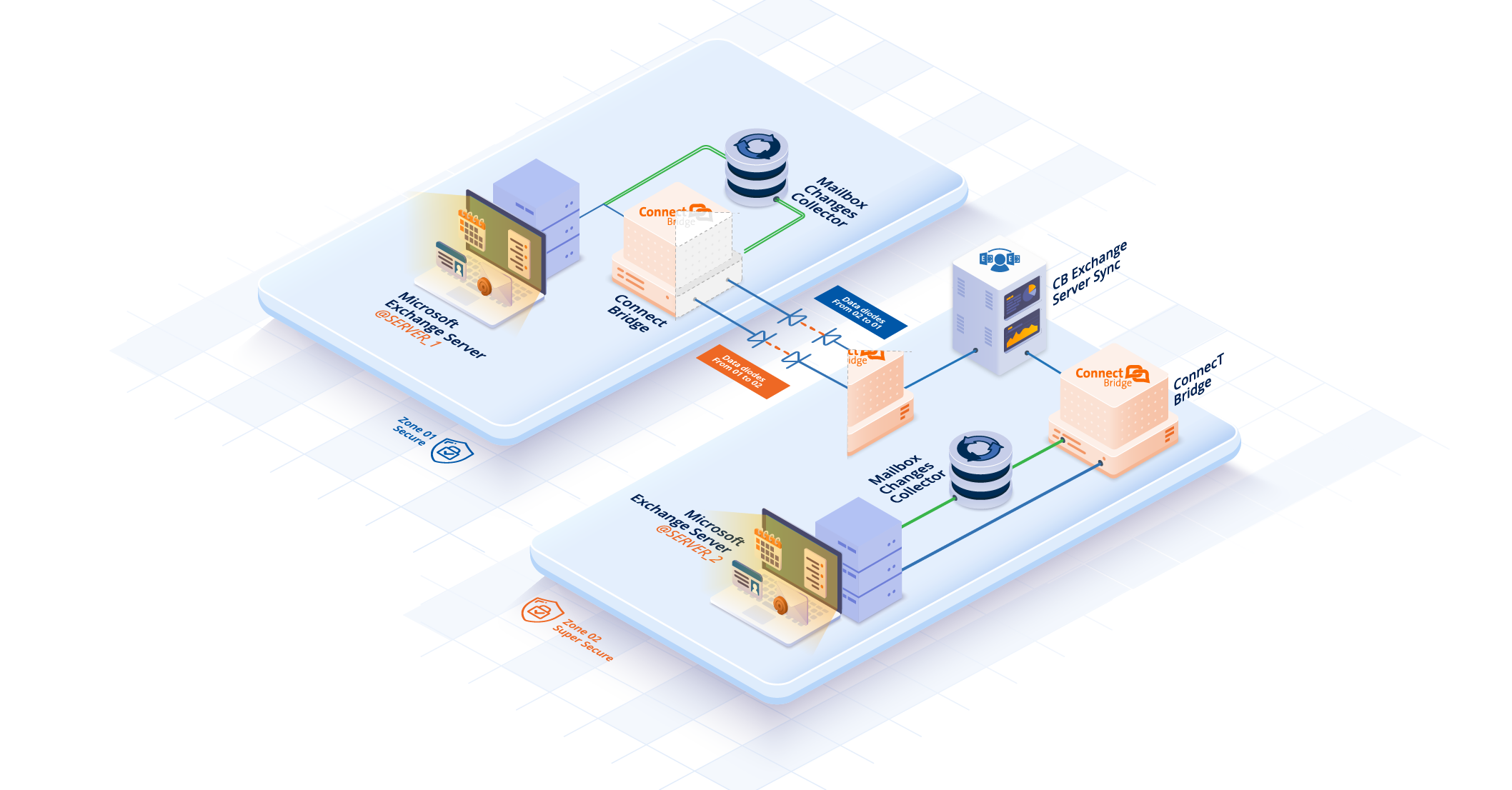
Meanwhile, Zone 1 is a semi-trusted area with field teams and other personnel that require access to email and calendar data for coordinated execution.
Using CB Exchange Server Sync, in combination with data diodes, makes it possible to have secure and controlled synchronization of email and calendar availability from the Zone 2 server to Zone 1.
It is even possible to do a bidirectional setup. In that scenario, each zone might even serve as a backup for the other, but in a different way from traditional backups. In this case, given the active, ongoing synchronization, you can instantly use the other zone to operate, which is quite different from restoring a classical backup.
Building Resilience and Trust Through Sovereignty
As demonstrated by the examples above, the future demands blending communication with security and control. Global enterprises must invest in interoperable, secure technologies that not only shield data but also support continuous operation and business continuity, preventing outages from cascading into crises and empowering teams to thrive in disconnected scenarios.
To discover how your organization, whether a bank, government agency, or critical industry provider, can benefit from air-gapped, sovereign communication, visit CB Exchange Server Secure Sync with Data Diodes.
References
- "German armed forces to use Google Distributed Cloud Air-Gapped solution" Data Center Dynamics, June 6, 2025
- “Data protection and privacy laws now in effect in 144 countries“ International Association of Privacy Professionals, January 28, 2025
- "Google to provide air-gapped Distributed Cloud to German Bundeswehr" Techzine Europe, June 2, 2025
- "Key Takeaways From The Google Cloud Digital Sovereignty Summit 2025" Forrester Blog, November 15, 2025
- "Europe Must Accelerate Cloud Investment to Unlock €1.2 Trillion in AI-Driven Growth" Google Cloud Press Release, November 13, 2025

About the Author

By Ana Neto, technical advisor at Connecting Software.
“I have been a software engineer since 1997, with a more recent love for writing and public speaking. Do you have any questions or comments about this article? I would love to have your feedback, leave a comment below!"