
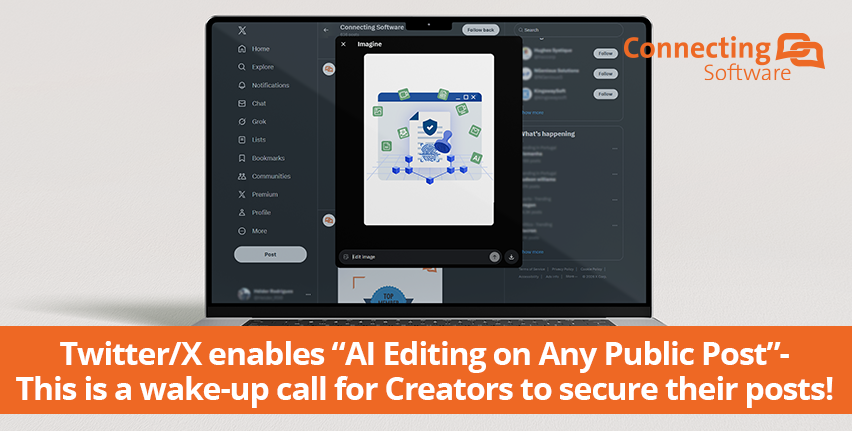
Last month, a small feature on X (formerly Twitter) triggered a big reaction across the creator community. A new “Edit Image” option, powered by Grok, allows users to modify any public image on the platform with a single click.
No straightforward opt-out. No notification to the original poster.
For some, this is a playful and inevitable evolution of social media. But for many artists, influencers, creators, and designers, it feels like a line “quietly” crossed.
This article looks at what changed, why reactions are so strong, where the debate becomes nuanced, and how verifiable proof tools like Truth Verifier help creators establish authorship in an environment where images can be endlessly altered.
What happened
The feature itself is simple: any image posted publicly on Twitter/X can now be AI-edited directly on the platform - adding elements, changing backgrounds, or altering style with prompts. Unlike the usual reposting or manual AI tools, the friction here has dropped to almost zero.
Several factors made this feature newsworthy:
- There is currently no clear way to opt out.
- The original creator is not notified when their image is edited.
- Standard AI-protection tools like Glaze and Nightshade, designed to disrupt AI training, appear ineffective because the system operates directly on a single image rather than a dataset.
Some of these points were even raised in a Reddit thread on r/Twitter and amplified by artists testing the feature publicly, including a Japanese illustrator whose glazed artwork (supposedly protected) was still successfully edited by the tool.
Why creators are reacting so strongly
The backlash was not your usual “AI is stealing art.” After reading dozens, if not hundreds, of comments, the deeper issue surfaced as control over creations, not ideology.
Creators already live in a reality where images can be downloaded, remixed, or reposted anywhere. What’s different here is the platform-level endorsement. By embedding AI editing directly into published works, Twitter/X is no longer a passive host - it evolved into an active participant.
For creators - game artists, concept designers, illustrators, photographers, journalists - this feature matters because images are assets tied to client trust, licensing, and future work – not just abstract expressions.
When alteration is simple and frictionless then circulation of second-hand work without context, attribution, or consent becomes the standard. Where is the line between derivative, parody, and misuse?
The other side of the argument
As we continued to read and search, we found the counterpoints. For the sake of this discussion, it is important to acknowledge them.
Some users argue:
- AI editing has become common; this feature just reduces the number of steps.
- Tools like Glaze were never universal solutions; they were created only for specific model types.
- Open and freemium platforms naturally evolve toward reuse (using generative AI or other tools); creators who want control should choose closed or portfolio-based options.
These arguments reflect a tension already present in digital platforms: reach versus control. Twitter/X remains one of the most influential discovery engines for artists. Alternatives exist (eg: BlueSky), but often with significantly less exposure.
These counterpoints are not a moral standoff - they are the other perspective within this complex discussion.
Why this matters beyond artists
While artists are the most visible voices with clear repercussions, the implications extend far beyond them.
- Game studios share early concept art.
- Indie developers post UI mockups.
- Photographers upload personal or client photos.
- Everyday users share family images.
The question comes down to:
If an image can be changed instantly and redistributed, how do you later prove what was original, and when?
This is not about preventing change. It’s about preserving verifiable origin in an environment where transformation is effortless.
Creative Bloq, 80 Level, and broader IP bodies have already underlined similar risks around attribution, consent, and provenance as AI tools become native to platforms rather than remain external.
From prevention to proof
Creator tech in the past few years has focused on prevention: poisoning datasets, blocking scrapers, or opting out of training. This juncture advances into a different reality. When platforms themselves enable modification, prevention alone is fragile.
A different framing emerges - one focused on proof rather than restriction.
Truth Verifier for IP Creators is built on a simple premise:
Prove what you had, when you had it, and in what state it was in.
Instead of desperately trying to stop every possible misuse, creators can establish verifiable evidence of authorship and state it at a specific moment in time. That evidence can later support claims like “I was the first creator of this content, and here is my proof.”
This shift - from blocking to documenting - aligns more closely with how the internet is evolving.
All of which allows creators (from game developers to photographers) to publish wherever they want, knowing they can prove they were first.
.
Contact us at: https://www.connecting-software.com/contact
OR
Try it for FREE:
Truth Verifier for IP Creators: https://truth-verifier.com/landing
Truth Verifier for Journalists: https://truthverifier.news/landing


By Francisco Rodrigues, Product Manager
"I write about how software integrations can adapt to business environments and respond to industry-specific demands. I want to show enterprises the road to streamline processes, eliminate bottlenecks, and ensure compliance by empowering teams and C-suite executives with the right tools."