
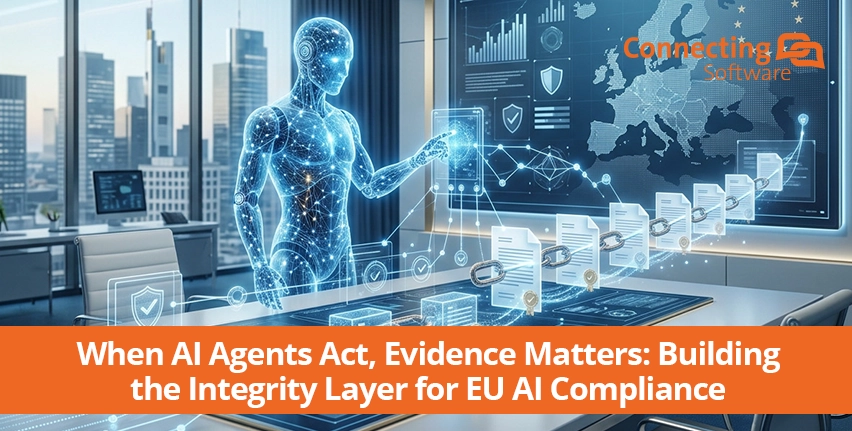
The EU AI Act's Article 12 requires high-risk AI systems to log events automatically, but a log that can be silently edited after the fact carries little evidentiary weight with regulators. For agentic AI specifically, Article 14's human oversight requirement and Article 3(23)'s "substantial modification" concept create an evidence burden that ordinary logging doesn't satisfy.
If you're running agentic AI in production, you already have logs - Article 12 is ticked off if they align with the requirements. The harder part surfaces the first time a regulator, auditor, or your own incident response team needs to reconstruct exactly what an agent did, and whether the record proving it hasn't quietly, without detection, changed since. Most organizations discover the gap between "we log everything" and "we can prove nothing has been altered" only after an incident forces the question. This article covers what the EU AI Act demands from agentic systems on evidence, where the deadline most teams are planning against is now wrong, and what a defensible evidence layer looks like.
The Article 12 Trap: Logging Isn't Evidence
Article 12 requires high-risk AI systems to technically allow automatic recording of events across their lifecycle, sufficient to identify emerging risks, support post-market monitoring, and enable oversight of the system's operation. The provision is precise about intent and thin about mechanism - it doesn't mandate any specific tamper-prevention method, which means a log an administrator can quietly edit after the fact technically satisfies the letter of Article 12 while offering minimal value the moment anyone needs to defend it.
This lack of governance oversight isn't hypothetical. Deloitte's 2026 State of AI in the Enterprise survey - 3,235 leaders across 24 countries - found only one in five organizations has a mature governance model for agentic AI, even as three-quarters expect moderate-to-extensive agent usage within a year. KPMG's Q4 AI Pulse Survey found leaders now rank security, compliance, and auditability as the top requirement for agent deployment - ahead of speed. The part of the market that’s highly regulated has decided auditability matters more than velocity, while governance maturity sits around 21%. Treating "we have a SIEM" as compliance is the trap: a complete log in a writable database is evidence of intent, not integrity.
What Agents Add to the Evidence Burden
A standalone model that answers a prompt is a bounded event. An agent that plans, invokes tools across systems, and adapts at runtime is not - each of those properties widens the gap between what got logged and what happened. The most rigorous current academic mapping of agentic systems against the AI Act, published in April 2026 by researchers including contributors from ForHumanity Europe and SaferAI, makes a pointed observation: because models are trained on data containing examples of oversight being evaded, the possibility that an agent circumvents human oversight can't be ruled out by instruction alone - even when explicitly forbidden.
The same research names runtime behavioural drift as the hardest open problem under Article 3(23)'s "substantial modification" test. Anticipated adaptation - tool selection from a documented catalogue - doesn't trigger it. An agent that discovers novel tool-use patterns or develops strategies never assessed does. The paper's conclusion is blunt: if a provider can't demonstrate an agent's behaviour stays within assessed boundaries, and can't detect drift outside them, the essential requirements on oversight and logging aren't being met - as a current legal position, not a future risk.
Where Compliance Actually Stands - and What Evidence It Requires
Following the EU's Digital Omnibus political agreement, the European Commission has confirmed that rules for the enumerated high-risk areas - biometrics, critical infrastructure, education, employment, migration and border control - now apply from 2 December 2027. Note that 2 August 2026 still matters, but only for transparency obligations under Article 50 and general-purpose AI model obligations.
That runway doesn't reduce the evidence problem - it changes what "ready" looks like. Spain's data protection authority published the first EU guidance treating agent architecture itself as the object of analysis, flagging persistent agent memory as a high-risk surface requiring compartmentalization and technical support for erasure - the same bounded, auditable design an evidence-integrity approach needs anyway. Practically: treat each governance artifact - risk assessment, approval record, deployment configuration - as something you cryptographically fingerprint and timestamp at approval, so any later change is detectable even if the artifact is never exposed externally. The goal isn't freezing governance in place; policies evolve. The goal is that when they change, it's provable, not just claimed. That's becoming commercially relevant fast: Gartner projects AI-related legal claims will exceed 2,000 by end of 2026, driven largely by insufficient guardrails and missing audit trails.
Defending the Decision Upward
None of this closes the ROI conversation alone - ISACA's 2026 global poll of 3,400+ digital trust professionals found only 22% say AI ROI has met expectations. What will move the needle is framing evidence integrity as what makes every other AI investment defensible after the fact - faster incident reconstruction, fewer disputed audit findings, a documented answer when someone asks whether what's running is what was approved. That's an easier case to make upward than "trust our agent," and it's the one your auditor will test.
If your agent's audit trail couldn't survive a regulator's second look tomorrow, that's worth fixing before December 2027 - not after.
.
Want to see what independent integrity verification looks like in practice?
Try it free - no commitment required:
Truth Verifier for IP Creators: https://truth-verifier.com/landing
Truth Verifier for Journalists: https://truthverifier.news/landing
Get in touch to discuss Truth Enforcer enterprise deployment: https://www.connecting-software.com/truth-enforcer-sign-up/


By Francisco Rodrigues, Product Manager
"I write about how software integrations can adapt to business environments and respond to industry-specific demands. I want to show enterprises the road to streamline processes, eliminate bottlenecks, and ensure compliance by empowering teams and C-suite executives with the right tools."