
Key Takeaways
Digital evidence preservation is the process of keeping relevant records available while maintaining reliable proof of their:
A) integrity (the record has not changed),
B) provenance (where it came from and who created it), and
C) chain of custody (an unbroken account of who handled it, when, and how).
This preservation becomes critical when a digital record later needs to be relied upon in an investigation, litigation, or other formal proceedings.
This guide explains what qualifies as digital evidence, when preservation is needed, and how organizations can establish a repeatable process based on the principles of NIST, ISO/IEC 27037, and SWGDE.
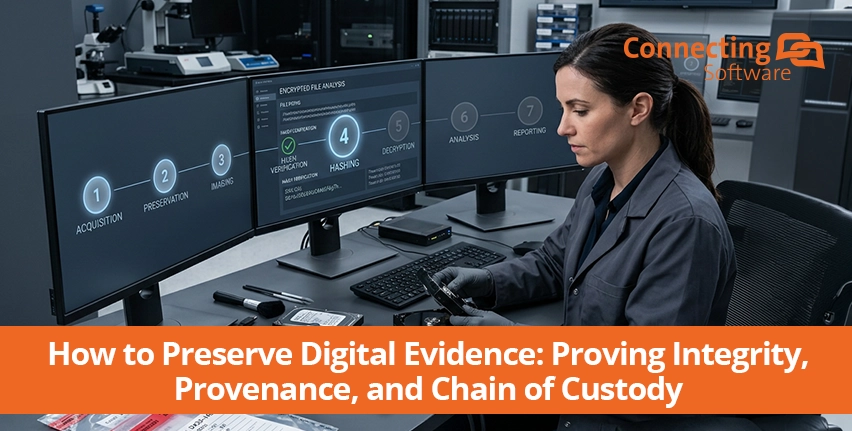
The process is organised into seven stages:
- Identify — establish what the evidence is
- Preserve — prevent alteration, destruction, contamination, or unauthorised access
- Fingerprint — compute a cryptographic hash of the record so that any later change becomes detectable.
- Record — document who collected the record, when, from where, and by what method.
- Secure — store the record and its documentation under access control, with every access logged.
- Verify — recompute the hash whenever needed and confirm it still matches the original.
- Present — produce the record together with the documentation that establishes its integrity, provenance, and chain of custody.
How to “Fingerprint” and “Verify” digital evidence
Explore the tool that handles both stages for you. It hashes your record, timestamps the hash so the date can’t be backdated, and proves on demand that the document is the same one you preserved.
What counts as digital evidence?
A precise and forensic definition, used by NIST, is: Digital evidence is information of probative value that is stored or transmitted in digital/binary form.
“Probative value”, as referred by Australia’ Evidence Act and US’ Federal Rules, means that the information can help establish a fact that matters to the investigation or case. So, the fact that something is digital does not automatically make it evidence; it becomes evidence when it has potential relevance to proving or disproving something.
Outside of courtrooms, in enterprises, digital evidence can be any digital record that may later be needed to establish what happened, what was agreed, what was approved, or what information existed at a particular time. In other words, it is not limited to a single court case or isolated investigation. It can be contracts and signed documents, financial and accounting records, emails and attachments, intellectual property records, system and application logs, cloud files and exported records.
When do businesses need preservation?
In all workflows, the common thread you will see is how an individual must establish a fact, defend a conclusion, or demonstrate that a required process was followed - using records as proof. It connects with the concepts of evidence, storing it, and probative value.
They all are evidence-driven workflows where businesses must reconstruct events, establish accountability, demonstrate that obligations or controls were satisfied, and produce defensible proof to an internal or external decision-maker.
|
Domain |
Workflow |
Need |
|
Legal |
Litigation, investigation, eDiscovery, contractual disputes, regulatory response, IP disputes. |
Establishing what happened, the chain of custody and timeline, and delivering a defensible output. |
|
Audit |
Financial and internal audits, regulatory examinations, control testing, remediation. |
Evaluating how everything was set in place, reviewed, and operated accordingly while noting and correcting deficiencies. |
|
Compliance |
Records retention, control-operation evidence, access and authorisation, incident and breach response, third-party oversight, data governance. |
Determine that records and controls were followed and reviewed considering access and data handling with proper governance. |
The consequences of preservation failure
The consequences of inadequate preservation are real. In September 2022, the U.S. Securities and Exchange Commission announced enforcement actions against 16 Wall Street firms for widespread failures to maintain and preserve electronic communications. The firms agreed to pay more than $1.1 billion in combined penalties. The SEC said that the failures deprived its investigators of communications that should have been available during regulatory investigations.
In 2023, another 11 firms were charged for failures to maintain and preserve electronic communications, with the firms agreeing to pay a combined $289 million in penalties. The SEC described these failures as violations of federal securities-law recordkeeping requirements and again emphasized the importance of preserving electronic communications for regulatory oversight and investigations.
And the risks also extend beyond regulatory recordkeeping. In the United Kingdom, the High Court found Raymond McKeeve to be in contempt of court after electronic material was destroyed in circumstances where preservation obligations applied. The court subsequently imposed a £25,000 fine and made significant costs orders. Ocado, the entity, reported that its legal costs had reached approximately £1.1 million. Mr. McKeeve, the individual involved, incurred approximately £615,000 in defence costs.
Recordkeeping and digital evidence preservation are closely connected. Recordkeeping maintains reliable organizational records; evidence preservation protects information that may later be needed to establish what happened.
The lesson is simple: do not just keep digital information - preserve it so you can prove what it is and why it can be trusted when it matters.
The 7 steps of digital evidence preservation
The purpose of an enterprise evidence-preservation SOP is to establish a small set of mandatory controls that protect the integrity, authenticity, traceability, and reproducibility of evidence from the moment it is identified through its eventual presentation or disposition. The three principal sources of guidance used to create this SOP and that you can consult to create your own, are the:
- ISO/IEC 27037:2012 Information technology - Security techniques - Guidelines for identification, collection, acquisition and preservation of digital evidence;
- Scientific Working Group on Digital Evidence’ (SWGDE) Best Practices for Digital Evidence Collection (and 17-F-002-2.1, 18-F-002-2.0, 21-F-001-1.1, 23-F-004-1.1);
- NIST SP 800-86’ Guide to Integrating Forensic Techniques into Incident Response and NIST IR 8387 Digital Evidence Preservation - Considerations for Evidence Handlers.
Your governing rule should be: Never modify what you cannot replace; never transfer what you cannot trace; never rely on evidence whose integrity you cannot verify.
|
1 – IDENTIFY ESTABLISH WHAT THE EVIDENCE IS Identify the source, state, scope, condition, unique identifiers, and authority for collection. ! Determine whether volatile data needs immediate preservation. |
2 – PRESERVE PROTECT THE ORIGINAL Prevent alteration, destruction, contamination, or unauthorised access before examination. ! Minimise interaction and document every stage-changing action. |
|
3 – FINGERPRINT CREATE A CRYPTOGRAPHIC IDENTITY Acquire an appropriate forensic copy and generate a cryptographic hash for the resulting evidence. ! Record the algorithm and complete hash value. |
4 – RECORD MAKE THE PROCESS RECONSTRUCTABLE Capture who, what, when, where, how, tools, results, errors, observations, and deviations. ! Maintain chain of custody for every transfer. |
|
5 – SECURE SECURE EVIDENCE THROUGHOUT ITS LIFECYCLE Store verified master evidence in controlled, access-restricted storage, separate from working copies. ! Apply access, retention, and protection controls. |
6 – VERIFY PROVE PRESERVATION REMAINS INTACT Confirm acquisition completed as intended and recheck hashes during defined preservation events. ! Review errors, limitations, transfers, and fix checks. |
|
7 – PRESENT PRESERVE THE EVIDENCE AND ITS INTEGRITY – NOT ONLY THE DATA Present the evidence with its provenance, integrity, custody, acquisition, and handling records. Show what it contains, and why it can be trusted. |
|
This is not intended to replace specialized forensic procedures. SWGDE expressly notes that its best-practice documents are not training manuals, are not all-inclusive, and may not apply to every circumstance. Where a situation requires deviation, the deviation and actions taken should be thoroughly documented.
Chain of custody: the lifecycle control
Every transfer of evidence should be traceable to a unique evidence identifier and should record, at minimum, who transferred it, who received it, when the transfer occurred, and why it occurred. SWGDE 17-F-002 explicitly identifies these elements as the minimum chain-of-custody information for digital evidence transfers. The objective is not bureaucratic complexity. It is continuity. At any point, the organization should be able to answer:
- Where is the evidence?
- Who has custody?
- When did custody change?
- Why did it change?
- Was its integrity verified?
If those questions cannot be answered, the evidence management process has a traceability gap.
Note that the strength of an SOP is that the controls remain stable while the implementation becomes more sophisticated. A small organization might use a controlled evidence register, standardized acquisition forms, cryptographic hashing, encrypted storage, and documented custody transfers. A larger enterprise can progressively add role-based access control, immutable or write-protected evidence repositories, automated hash verification, tamper-evident audit logs, etc. The important point is that these capabilities extend the initial controls rather than replacing them.
Consult the Reference framework for all the content and other specific use cases that may better fit your own workflow.
Enterprise challenges
To start working, it’s also important to consider common challenges that you may face, even if there’s a plan in place.
|
Integrity loss |
Evidence may become unreliable or inadmissible if you cannot demonstrate that it was unchanged. |
|
Custody gaps |
Missing documentation about who, when, and how can undermine its authenticity in court. |
|
Volatile data |
RAM, logs, temporary files, cloud data, and other volatile information may disappear. |
|
Volume |
Massive datasets increase the risk of relevant data being overlooked or inadequately preserved. |
|
Encryption & distributed data |
Access, acquisition, and provenance become harder with distributed systems and locations. |
|
Missing metadata |
Loss of timestamps, provenance, or acquisition information can make evidence difficult to authenticate. |
The goal is always to face these challenges and turn digital evidence into a record the business can verify, explain, and defend.
Where integrity verification software fits
In the evidence-preservation workflow, we work with the “Fingerprint” and “Verify” stages: creating a cryptographic hash of the preserved record, securely establishing that hash at a known point in time, and later verifying that the record still matches. Connecting Software’s Truth Enforcer fits this specific requirement: it creates a cryptographic fingerprint of a file and records it in an immutable blockchain ledger, allowing the file to be checked later for changes without the underlying document leaving the organisation’s control.
Truth Enforcer could provide one discrete integrity control within those workflows: establishing and subsequently verifying the state of a record.
You can even Try it for Free - no commitment required:
Truth Verifier for IP Creators: https://truth-verifier.com/landing
Truth Verifier for Journalists: https://truthverifier.news/landing
Get in touch to discuss Truth Enforcer enterprise deployment
Sources
ISO
ISO/IEC 27037:2012 - Information technology - Security techniques - Guidelines for identification, collection, acquisition and preservation of digital evidence.
Source: https://www.iso.org/standard/44381.html
SWGDE
SWGDE 18-F-002-2.0 - Best Practices for Digital Evidence Collection.
Source: https://www.swgde.org/documents/published-complete-listing/18-f-002-2-0/
SWGDE 17-F-002-2.1 - Best Practices for Computer Forensic Acquisitions.
Source: https://www.swgde.org/documents/published-complete-listing/17-f-002-2-1/
SWGDE 21-F-001-1.1 - Best Practices for Acquiring Online Content.
Source: https://www.nist.gov/standard/1036
SWGDE 23-F-004-1.1 - Best Practices for Digital Evidence Acquisition, Preservation, and Analysis from Cloud Service Providers.
Source: https://www.nist.gov/standard/3351
NIST
NIST SP 800-86 - Guide to Integrating Forensic Techniques into Incident Response.
Source: https://nvlpubs.nist.gov/nistpubs/legacy/sp/nistspecialpublication800-86.pdf
NISTIR 8387 - Digital Evidence Preservation: Considerations for Evidence Handlers.
Source: https://nvlpubs.nist.gov/nistpubs/ir/2022/NIST.IR.8387.pdf


By Francisco Rodrigues, Product Manager
"I write about how software integrations can adapt to business environments and respond to industry-specific demands. I want to show enterprises the road to streamline processes, eliminate bottlenecks, and ensure compliance by empowering teams and C-suite executives with the right tools."