
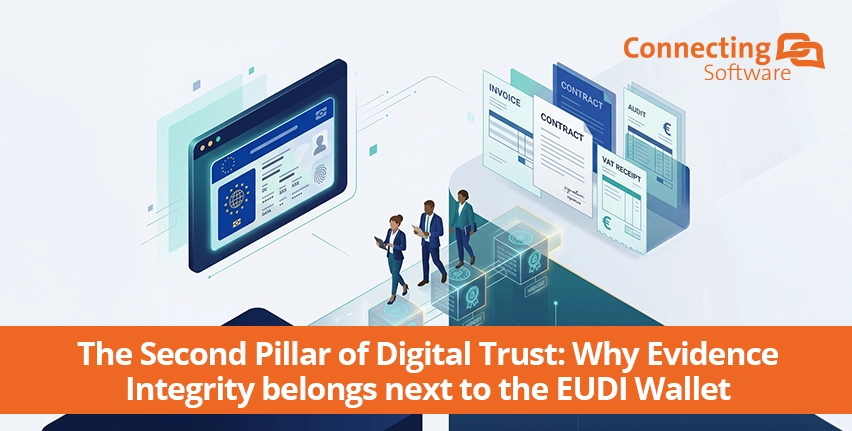
The European Commission has set a formal target to cut SME administrative costs by at least 35% during this mandate, against a recurring EU-wide burden of roughly €150 billion a year - and it separately estimates the 2023 VAT compliance shortfall at €128 billion. These numbers are the backdrop against which the EUDI Wallet rollout is happening, and they explain why identity alone, however well engineered, is only a part of what a fully digital Single Market needs to function.
The EU Digital Identity Wallet and eIDAS trust services are building the first pillar: a regulated, cryptographically strong answer to "who issued this, and can it be trusted." That work is real, it's in production, and it deserves the attention it's getting. This piece is about the second pillar sitting alongside it - the one that answers a related but distinct question: once a document exists, can its original state still be proven, independently, for as long as anyone might need it?
Two Questions, Two Layers
Under eIDAS Article 35, a qualified electronic seal carries a legal presumption of data integrity and must be recognized across every Member State. That's a durable answer to provenance. It establishes origin at the moment of sealing, inside the regulated trust framework.
Provenance and persistence are different jobs, and both are needed in a system built to last decades. The EU's own 2030 Digital Compass anticipates this by calling for cross-border exchange of "data and evidence" and by naming infrastructure like the European Blockchain Services Infrastructure as part of getting there - a signal that the institutions themselves see evidence portability as its own workstream, running in parallel with wallet rollout rather than trailing behind it.
A complementary evidence layer sits exactly here: not inside the issuer-wallet-verifier chain, and not competing with it, but running alongside it - giving organizations a way to prove a document hasn't changed since creation, independent of whichever platform, vendor, or portal happened to be in use at the time.
Why This Is Institutional, Not Just Operational
Digital sovereignty. When evidence lives only inside one ERP, one SaaS platform, or one national system, its survival is tied to that system's survival. Portable, independently verifiable evidence gives an organization - and by extension the EU - a form of resilience that doesn't depend on any single vendor staying in business.
The Single Market. Cross-border trade runs on trusted documentation moving between systems that were never designed to talk to each other. The Commission has repeatedly flagged fragmented verification as friction in that flow; evidence that carries its own proof of integrity travels more easily across those boundaries.
SME cost reduction. A meaningful share of recurring compliance cost comes from rebuilding the same audit trail for every audit, every jurisdiction, every counterparty. Evidence that can be reused - proven once, verified independently many times - is a direct lever against the Commission's own 35% target, not a theoretical efficiency claim.
Four Places This Already Applies
Tax and audit. Invoices need to hold up years after issuance. A cryptographic fingerprint and trusted timestamp, generated at the moment of issuance, let that proof survive platform migrations and vendor changes entirely intact.
Dispute resolution. Cross-border litigation increasingly turns on whether digital records can be trusted. Research into digitalized European small-claims procedure points to blockchain-anchored evidence to reduce challenges over tampering and strengthen confidence in what's presented.
Cross-border procurement. Legal certification processes like apostilles remain necessary for now - an evidence layer doesn't replace them. What it adds is a fast, independent way to confirm a document hasn't been altered since issuance, closing one of the slower steps in cross-border deals.
Qualifications and credentials. While fully digital-credential adoption continues, PDFs and scans remain common. Proving a document's unchanged state since issuance removes friction from cross-border recognition without waiting for every issuer to digitize first.
A Working Example: Truth Enforcer
Truth Enforcer is one implementation of this second pillar - a hash-based verification system built on a create-seal-verify model. Sealing a file generates a cryptographic fingerprint and timestamp without storing or exposing the document itself. Anyone holding the original file can later verify that fingerprint independently, with no dependency on the issuing platform or a third party. It doesn't stop a document from being edited - it makes any edit provably visible.
That's the design principle for a layer meant to run beside the EUDI Wallet rather than inside it: identity establishes who issued something; this establishes that what was issued hasn't moved.
In January 2026, Truth Enforcer received the SME Europe Award for Innovation and Future Readiness at the European Parliament, recognizing its contribution to digital security and compliance - an early signal that this second pillar is already part of the institutional conversation, not a proposal waiting for one.
The EUDI Wallet is establishing how Europe verifies identity. The next stretch of that same infrastructure is establishing how Europe verifies that evidence stays intact over time - across systems, vendors, and years. Treating both as core building blocks of the same digital trust architecture, rather than one as foundation and the other as afterthought, is what turns "identity you can trust" into "evidence you can defend."
.
Want to see what independent integrity verification looks like in practice?
Try it free - no commitment required:
Truth Verifier for IP Creators: https://truth-verifier.com/landing
Truth Verifier for Journalists: https://truthverifier.news/landing
Discuss Truth Enforcer enterprise deployment: https://www.connecting-software.com/truth-enforcer-sign-up/


By Francisco Rodrigues, Product Manager
"I write about how software integrations can adapt to business environments and respond to industry-specific demands. I want to show enterprises the road to streamline processes, eliminate bottlenecks, and ensure compliance by empowering teams and C-suite executives with the right tools."