
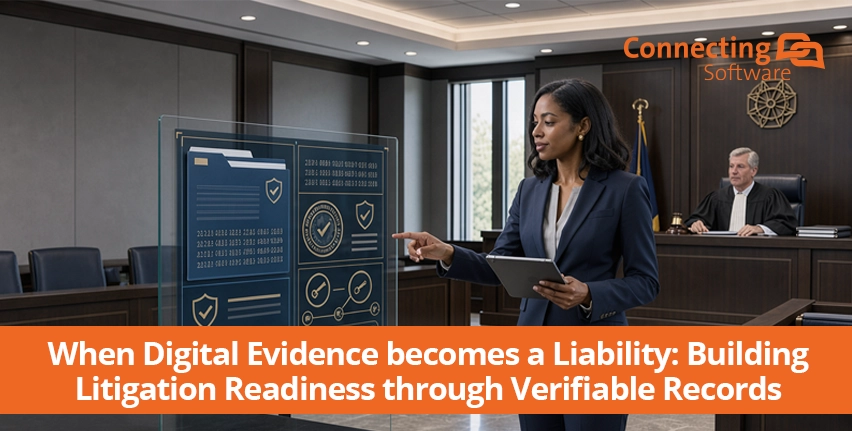
For many enterprises, the challenge appears after the incident has already happened. A contract dispute emerges. A regulatory investigation begins. A customer challenges a transaction. Internal teams are asked to prove what happened, when it happened, and whether the records being presented can be trusted.
As modern businesses generate enormous volumes of logs, audit trails, system events, communications, and transaction records the quantity of data will rarely be the main bottleneck.
The problem is evidence credibility.
Digital evidence is increasingly distributed across applications, cloud platforms, third-party systems, and operational databases. When disputes occur, businesses often discover that their evidence chain was never designed for external challenge. Records may exist, but proving authenticity, chronology, and integrity becomes significantly harder.
For CISOs, security architects, and compliance leaders, this creates a different type of risk: not preventing an incident but failing to prove the truth afterwards.
From Data Availability to Evidence Assurance
Enterprise environments have moved from centralised systems to interconnected digital ecosystems. Business processes now cross SaaS platforms, APIs, cloud infrastructure, partners, suppliers, and automated workflows.
This creates operational efficiency, but it also changes the requirements for trustworthy evidence.
Traditional logging systems were primarily designed for monitoring, troubleshooting, and security operations. They answer questions such as:
- What event occurred?
- Which user accessed a system?
- When did a transaction take place?
However, litigation, regulatory review, and contractual disputes require additional questions:
- Can the business prove the record existed at a specific point in time?
- Can the record owner demonstrate it was not altered?
- Can an external party independently verify authenticity?
This distinction matters because evidence collected after an event is often treated differently from evidence created with integrity controls from the beginning.
The emerging requirement is evidence assurance: records that are not simply stored, but verifiably trustworthy.
Businesses can collect evidence but cannot always defend it
Many businesses assume that standard audit logs, database records, and administrator controls provide sufficient proof.
That assumption creates exposure.
The failure point? Evidence fragmentation.
Relevant information may exist across multiple platforms:
- Identity systems
- Application logs
- Email archives
- Cloud platforms
- ERP systems
- Partner environments
Reconstructing a timeline becomes a manual process, increasing the risk of missing context or conflicting records.
What else can become an issue? Administrative trust dependency.
Traditional systems often rely on privileged administrators. While access controls and monitoring reduce risk, an opposing party may still question whether records could have been modified by authorised personnel.
The problem culmination of these models? Weak evidence preservation.
A timestamp alone does not necessarily prove integrity. A record showing a date and time does not automatically prove that the underlying content has remained unchanged.
The result is a gap between operational confidence and legal defensibility.
Evidence Integrity, Regulation, and the European Trust Infrastructure Shift
European regulation is accelerating the need for trustworthy digital interactions.
The European Digital Identity Wallet (EUDIW), introduced through the updated European digital identity framework, is designed to allow users to securely store, manage, validate, and share identity data and electronic attestations. It also supports qualified electronic signatures and electronic seals (eIDAS).
The European Commission describes the wallet ecosystem as being built around common standards and specifications to ensure interoperability between member states. Large-scale pilots have tested use cases across public and private services before broader deployment.
For enterprise security teams, this development is important because digital trust is moving closer to the transaction layer. Identity, attestations, signatures, and evidence authenticity are becoming connected capabilities rather than separate compliance activities.
A similar transformation is occurring with Digital Product Passports (DPPs). Under the Ecodesign for Sustainable Products Regulation (EU) 2024/1781, the European Commission is establishing infrastructure for product data exchange and verification, including a Digital Product Passport registry.
As supply chains become more digital, manufacturers and suppliers will need evidence that product information, certifications, and lifecycle records are authentic and unchanged.
Moving from Logs to Verifiable Evidence
A defensible evidence model does not replace existing security controls. It strengthens them.
The objective is not to store every operational event permanently on an immutable system. Instead, businesses should identify high-value evidence requiring stronger assurance.
Examples include:
- Contract approvals
- Compliance records
- Customer transactions
- Supply chain certifications
- Regulatory submissions
- Incident investigation evidence
A modern evidence integrity approach typically combines several mechanisms.
Time-sealed records
A trusted timestamp provides proof that information existed at a specific moment.
Integrity verification
Cryptographic hashing allows businesses to compare a stored fingerprint against later versions and identify changes.
Tamper detection
If evidence changes after creation, verification mechanisms can reveal the modification.
Blockchain-based evidence approaches are increasingly discussed because immutability can reduce risks associated with forgery, manipulation, and challenges to authenticity in digital evidence contexts.
The role of a platform such as Truth Enforcer is to provide an evidence assurance layer: creating time-sealed, integrity-verifiable records that businesses can use alongside existing security, compliance, and governance systems.
Rather than replacing SIEM platforms, document management systems, or identity providers, this type of capability addresses a specific gap: proving that digital evidence can be trusted after the fact.
.
Want to see what independent integrity verification looks like in practice?
Try it free - no commitment required:
Truth Verifier for IP Creators: https://truth-verifier.com/landing
Truth Verifier for Journalists: https://truthverifier.news/landing
Get in touch to discuss Truth Enforcer enterprise deployment: https://www.connecting-software.com/truth-enforcer-sign-up/


By Francisco Rodrigues, Product Manager
"I write about how software integrations can adapt to business environments and respond to industry-specific demands. I want to show enterprises the road to streamline processes, eliminate bottlenecks, and ensure compliance by empowering teams and C-suite executives with the right tools."