
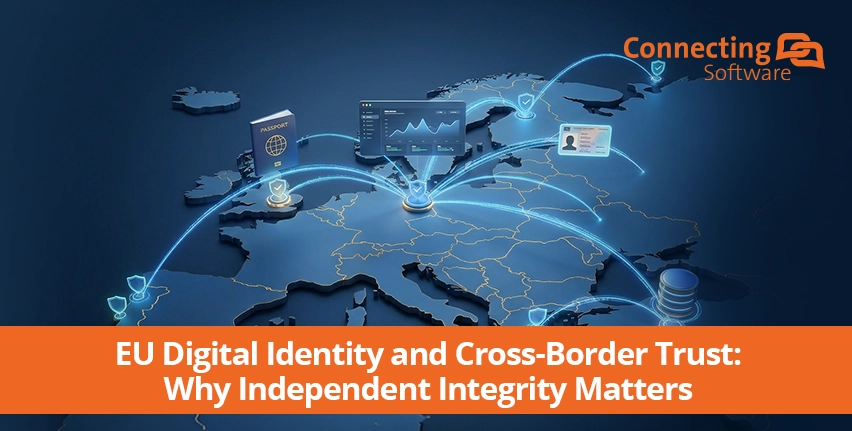
A citizen, employee, student or company that wants to prove a qualification, licence or civil-registry record across borders should not require a chain of PDFs, emails, certified translations, registry requests and in-person visits. Yet cross-border administration still depends heavily on evidence moving between fragmented systems - and on the receiving party deciding whether that evidence can be trusted.
The problem is no longer simply digitisation. A PDF may eliminate paper while preserving the underlying trust problem: how can the recipient prove that the document is authentic, unchanged and representative of the issuer's original record?
That distinction matters for compliance teams, public-sector technology leaders and organisations operating across jurisdictions. The European Union is already building infrastructure for automated evidence exchange and digital credentials. The next question is whether the evidence itself can carry independently verifiable proof of integrity.
This is where an integrity layer such as Truth Enforcer becomes relevant - not as a replacement for civil registries or government identity systems, but to establish neutral evidence that a particular digital document existed in a particular state at a particular point in time.
From Paper to Digital Credentials
Public administration has been moving from physical certificates toward digital evidence that can be exchanged between systems.
The European Commission's Once-Only Technical System (OOTS) is a significant example. Its architecture is designed to allow competent authorities in different EU Member States to exchange evidence automatically when a citizen or business requests it. The system can cover evidence associated with education, population registers, professional qualifications and other administrative procedures.
Digital credentials are developing in parallel. European Digital Credentials for Learning can represent diplomas, certificates and other learning achievements as digitally signed credentials. They are designed to make credentials machine-readable, shareable and verifiable, including across borders.
This is the right direction. But interoperability answers how evidence moves. It does not automatically answer every question about how the evidence's integrity is established and preserved over time.
Digital does not mean Trusted
Consider a cross-border transaction in which a business registry extract must be presented to another jurisdiction.
The European Commission's impact analysis describes a real consultation example in which a law firm reported that obtaining information needed to complete the cross-border acquisition of a Spanish company by a French company took almost two months, mainly because of delays obtaining an apostille for information received from the business register. The same analysis highlights continuing uncertainty around document acceptance, apostille requirements and translations in cross-border corporate situations.
The important lesson is broader than apostilles.
Even when a document becomes digital, the recipient still needs confidence about its origin, integrity and evidentiary status. An emailed PDF can be genuine. It can also be an altered copy of a genuine document. A scanned certificate can represent an authentic paper document. It can also be manipulated after scanning.
That creates a subtle control gap: organisations may have a process for obtaining evidence without having an independent mechanism for proving that the evidence has remained unchanged since its original state.
For a CISO or compliance leader, this is fundamentally an evidence-integrity problem.
EU’s Evolving Trust Framework
Europe's trust-services framework provides an important foundation.
Under the eIDAS framework, electronic seals can establish the origin and integrity of electronic documents, while electronic timestamps provide evidence that electronic information existed at a particular time. Electronic registered delivery can also provide evidence around the transmission and delivery of data.
The newer European Digital Identity framework expands the trust-services landscape further, including electronic attestations of attributes, validation and preservation services, electronic timestamps and electronic archiving.
The direction is therefore clear: digital government is moving toward evidence that can be authenticated electronically rather than simply presented as a file.
But organisations should distinguish between authentication of the issuer and proof of the document's continuing integrity. These are related controls, not interchangeable ones.
Adding Independent Integrity Proof
The practical model is to introduce an independent integrity layer around important documents and records.
When an authoritative document is created or received, a cryptographic fingerprint can be calculated from its content. That fingerprint can then be sealed and timestamped without storing the underlying document in the integrity system. Later, the current document can be fingerprinted again and compared with the original proof.
If the fingerprints match, the content corresponds to the recorded state. If they do not, the document has changed.
This is the role Truth Enforcer can play in an existing environment.
The distinction is important: Truth Enforcer provides an additional, independently verifiable record of the digital information's integrity. It does not replace the authority that issued a birth certificate, professional licence, academic credential or company-register extract. It does not decide whether someone is legally qualified to practise a profession.
That makes it potentially useful at the transition point between authoritative source and downstream verification.
The European Commission's OOTS architecture already demonstrates the value of integrating existing national systems rather than replacing them with one central database. An integrity layer follows the same principle: augment the existing evidence ecosystem rather than attempting to rebuild it.
The decision test is straightforward: If a critical credential were challenged tomorrow, could your organisation prove not only where it came from, but that the evidence presented is identical to the verified state originally recorded?
If the answer is no, digitising the workflow has not fully solved the trust problem.
The future of cross-border public services is not simply paperless administration. OOTS, European Digital Credentials and the European Digital Identity framework show that the infrastructure for trusted digital exchange is already developing.
The next maturity step is making the evidence itself independently verifiable.
That is the role of an integrity layer such as Truth Enforcer: preserving defensible proof of the credential's digital state as it moves through the increasingly complex systems of cross-border administration.
Want to see what independent integrity verification looks like in practice?
Try it free - no commitment required:
Truth Verifier for IP Creators: https://truth-verifier.com/landing
Truth Verifier for Journalists: https://truthverifier.news/landing
Get in touch to discuss Truth Enforcer enterprise deployment: https://www.connecting-software.com/truth-enforcer-sign-up/


By Francisco Rodrigues, Product Manager
"I write about how software integrations can adapt to business environments and respond to industry-specific demands. I want to show enterprises the road to streamline processes, eliminate bottlenecks, and ensure compliance by empowering teams and C-suite executives with the right tools."