


"It does exactly as the name states. It replicates the permissions from Dynamics CRM to SharePoint. After a quick setup, it just works!"
– Richard Bosse, Team Lead Business Process Collaboration
at ORBIS Modern Work GmbH
Partner: ORBIS Group
Headquarters: Saarbrücken, Germany
Customers: Automotive and manufacturing organizations, mostly medium to large enterprises, primarily in the DACH region (Germany, Austria, and Switzerland)
Activity: Microsoft Dynamics 365 and Modern Workplace Consulting
Product: CB Dynamics 365 to SharePoint Permissions Replicator
Some problems only become visible once two systems are actually connected. That is exactly what keeps happening to ORBIS' Microsoft Dynamics 365 customers when they bring SharePoint into the picture, and it is why the firm keeps reaching for the same tool to fix it, project after project.
We spoke with Richard Bosse, who leads the Business Process Collaboration team at ORBIS Modern Work GmbH and has worked on CRM and SharePoint solution architecture across the ORBIS Group since 2018, about what keeps drawing his customers back to CB Dynamics 365 to SharePoint Permissions Replicator, four years after ORBIS first shared its experience with the tool.
A Problem That Is Obvious Once You Say It Out Loud
Richard Bosse's explanation of the product barely needs elaboration. Microsoft Dynamics 365 CRM and SharePoint don't share the same permission model, and there is no built-in way to keep them in sync, he pointed out. Customers typically connect the two systems and store CRM documents in SharePoint to cut storage costs and streamline collaboration. However, the detailed access rules they've spent years building in Microsoft Dynamics 365 simply don't carry over.
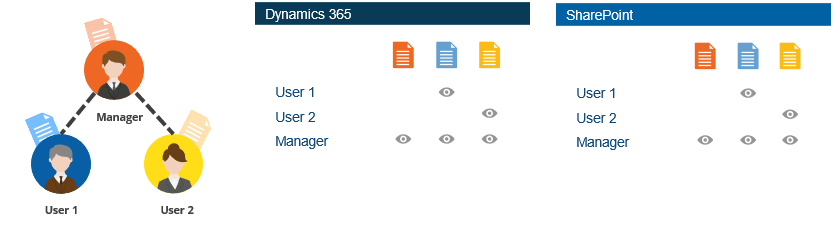
According to Bosse, once someone explains this to a customer, there's no need to convince anyone. "The very generic problem that both systems don't have the same permissions is immediately clear," he said. What takes more work is judging how complex a given customer's permission model actually is, and often it changes. Bosse called this part of the job squarely ORBIS's responsibility: assessing the setup and then, in anything beyond the simplest cases, recommending Connecting Software’s Permissions Replicator as what he described as the "hassle-free" route.
He also shared a telling anecdote about how invisible the tool becomes once it's running. "We noticed that our customers sometimes forget they have the Permission Replicator," Bosse admitted. "After it's working, no one really has to do anything. It's in the background, it's running."
The Problem ORBIS Sees Over and Over
Bosse traced a fairly consistent path to how customers stumble into this issue. They rarely start out with Microsoft Dynamics 365 and SharePoint already connected and then discover a permission gap. Instead, they typically already run a mature permission model inside Microsoft Dynamics 365, then decide to intensify how they handle documents across sales and service, growing frustrated with storing everything as notes and attachments. "They realize they need a document management system, and then they realize SharePoint basically integrates out of the box," Bosse explained, "but that’s exactly the moment they realize the permission gap."
That pattern shows up most often among ORBIS' automotive and manufacturing customers, a reflection of where the firm's own expertise runs deepest rather than the problem being industry-specific.
Interestingly, Bosse doesn't see privacy regulations like GDPR as a common motivator for fixing the permissions gap, although fixing it happens to close the exact access-control gap GDPR audits look for. In his consulting experience, the desire to separate business units comes up far more often, whether that's sales teams split by country or, in a recent project, divisions as distinct as automotive versus aerospace and defense. "Separation of data is, for me, more of a driver than GDPR," he noted.
Fast to Deploy, Easy to Forget
When it comes to project timelines, Bosse described the CB Dynamics 365 to SharePoint Permissions Replicator portion of any engagement as "mostly plug and play." It is almost never a standalone project: for ORBIS it typically rides alongside a larger Dynamics-to-SharePoint integration effort where most of the customization work happens elsewhere. ORBIS, he added, plans very few implementation days specifically for the permissions part, and rarely needs to touch its configuration beyond occasional table exclusions. Only once, he recalled, did a customer request meaningfully deeper changes.
The team's confidence in the product has grown to the point where trials are no longer part of the process. "We know the product well enough, and we are confident that it's a fit when we recommend it," Bosse remarked, crediting a strong trust relationship built up with both customers and Connecting Software over the years.
That confidence extends to deployment flexibility. While most of ORBIS' customers run the SaaS version, Bosse highlighted a recent on-premises project for Diözese Linz, a Catholic institution in Austria, where the Docker-based deployment made life considerably easier. "It makes it easier for the customer to handle on-premise installations efficiently," he observed.
Support That Holds Up Under Pressure
Asked about support, Bosse offered a grounded assessment rather than blanket praise. He described the support as consistently reliable, and said the support portal has generally worked well.
He recalled one case involving a minor bug that took a few weeks to resolve, and framed the wait as entirely reasonable. "I understand that, especially for a software as a service platform, you cannot immediately push a dirty hot fix," he said, drawing on his own experience in product management. "For support, you get all you would expect in terms of professional support for a SaaS platform.", he concluded.
Closing Thoughts
Asked to rate CB Dynamics 365 to SharePoint Permissions Replicator on a scale of zero to ten, Bosse settled on a nine, and was quick to clarify what stood between the product and a perfect score. His main suggestion centered on licensing for test and development environments, which he considers workable but still with potential to be simplified.
Everything else, he made clear, earns the product its high marks. "I really like that the configuration UI is accessible," he said, "and it just works for what you do. It's easy to handle."
Who is ORBIS?
Founded in 1986 in Saarbrücken, Germany, the ORBIS Group has grown into an international software and business consulting company with roughly 900 employees across offices in Europe, the United States, and China.
ORBIS Modern Work GmbH, the group's dedicated Microsoft 365 and digital workplace consultancy, supports customers on everything from Microsoft Dynamics 365 and SharePoint integration to broader digital transformation and cloud strategy.
What is CB Dynamics 365 to SharePoint Permissions Replicator?
When Microsoft Dynamics 365 documents are stored in SharePoint, the two platforms manage access independently. Microsoft Dynamics 365 enforces security through roles, business units, teams, and record ownership, but SharePoint is unaware of these rules. A user without CRM privileges to view a record can still open its documents directly in SharePoint, exposing confidential data.
CB Dynamics 365 to SharePoint Permissions Replicator closes this gap. Available on the market since 2014, this out-of-the-box solution automatically replicates Microsoft Dynamics 365 privileges as SharePoint permissions. Replication is triggered by changes in the CRM, such as adding a new document or moving a user to another team, so SharePoint permissions update automatically with no manual administration.
The result is a single access model: your documents stay protected automatically, and permissions management is effortless.